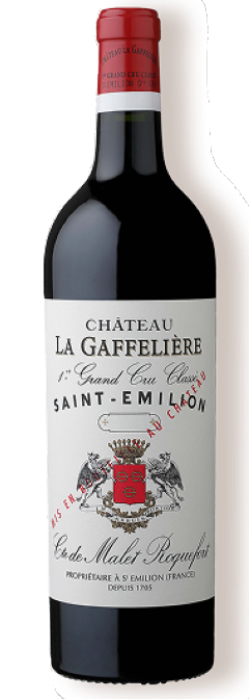
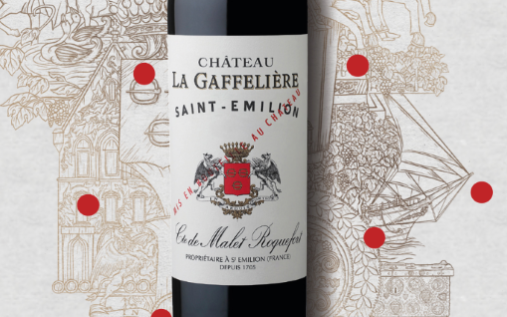
.Château La Gaffelière 2013
A wine of poise and classical Saint-Émilion charm, revealing aromas of blackcurrant, blackberry and plum layered with violet, cedar and subtle spice. The palate is refined and beautifully balanced, supported by silky tannins and fresh acidity that bring precision and energy to the wine. Notes of tobacco, graphite and dark chocolate add depth and complexity, leading to a long, elegant finish. A graceful expression of La Gaffelière that highlights finesse, terroir and understated sophistication.
Wine Profile
Region
:
Bordeaux
Classification
:
Premier Grand Cru Classe B
Appellation
:
Saint Emilon Grand Cru
LWIN
:
1011934
Flavours
Cedar
Tobacco
Violet
Plum
Graphite
Blueberry
Blackcurrant
Black Cherry
Dark Chocolate
Food Pair
Mature Cheese
Venison
Filet mignon
Beef Wellington
Classic Lamb Roast
Grilled Mustard Covered Rack of Lamb
Duck
About this WINE
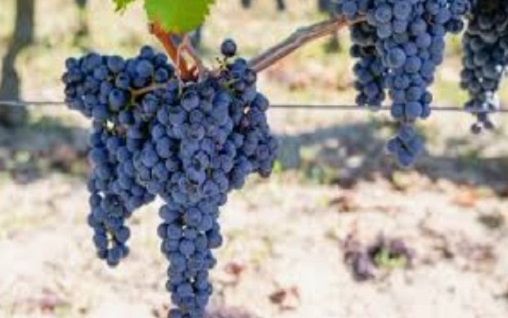
Cabernet Franc
Green bell peppers, fine tannins, red and blackberriesAs one of the most ancient and important varieties in the Bordeaux family, Cabernet Franc often fades in the limelight of its offspring; Cabernet Sauvignon. In comparison, Cabernet Franc is often lighter, less intense, and more aromatic.It is often tasted together with Cabernet Sauvignon and Merlot as the famous Bordeaux blend; a mix that is said to utilize the grape’s attractiveness. When going solo, Cabernet Franc produces tasty wines in cool and challenging areas, such as Washington (US) and Long Island (New Zealand).The Italian version,
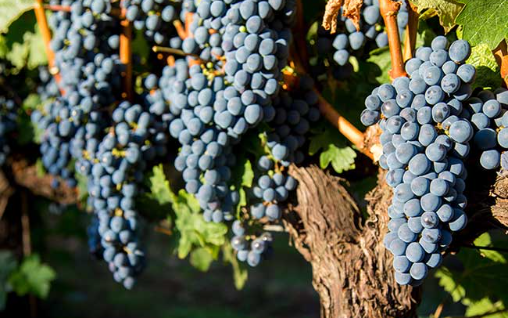
Merlot
Known as Cabernet Sauvignon’s partner in crime, Merlot is a soft, fleshy and easy to grow grape that ripens easily, which makes it one of the world’s most planted wine grapes. This plummy little chum makes a lovely blend with said partner-in-crime, softening the tannic structure of Cabernet Sauvignon, while adding fruit and flesh to the mix.Climate has a lot to say about the taste of Merlot. When the climate is hotter as in California, expect a more fruit-forward and soft Merlot, in contrast to the herbaceous and mineral character of cool-climate Merlots from Bordeaux.Merlot has had quite a jo
About this WINE
The Producer
.Few
estates in Bordeaux can claim a history as layered and enduring as Château La
Gaffelière. The land itself has been under cultivation since Gallo-Roman
times, with archaeological evidence — including Roman mosaics unearthed in the
vineyards — confirming viticultural activity stretching back nearly two
millennia. During the medieval period, the site housed a leper colony, and it
is from this chapter that the estate derives its evocative name: gaffet,
the old French word for a leper's cane.The
château as a winemaking estate began to take its modern form with the arrival
of the Comte...
.Few
estates in Bordeaux can claim a history as layered and enduring as Château La
Gaffelière. The land itself has been under cultivation since Gallo-Roman
times, with archaeological evidence — including Roman mosaics unearthed in the
vineyards — confirming viticultural activity stretching back nearly two
millennia. During the medieval period, the site housed a leper colony, and it
is from this chapter that the estate derives its evocative name: gaffet,
the old French word for a leper's cane.The
château as a winemaking estate began to take its modern form with the arrival
of the Comte de Malet-Roquefort in the 17th century, who established
the distinctive Gothic-influenced architecture still visible today from the
road leading into the village of Saint-Émilion. The family has maintained
unbroken ownership since 1705 — an extraordinary continuity spanning
over three centuries — making La Gaffelière one of the longest-standing
family-owned estates in all of Bordeaux.
The
château building itself is a testament to that layered history: a 15th-century
vaulted kitchen, 17th and 18th-century wings, and a 19th-century pigeon house
that was converted into a pool house in the 20th century. It is, in every
sense, a living archive of Right Bank wine culture.
02Terroir
& Vineyard
Château
La Gaffelière occupies what the family describes as a "golden
triangle" — a privileged site nestled between the celebrated slopes
of Château Ausone to the north and Château Pavie to the east, at the southern
entrance to the village of Saint-Émilion. This positioning is not incidental;
it places La Gaffelière at the confluence of two of the appellation's most
important terroir expressions.
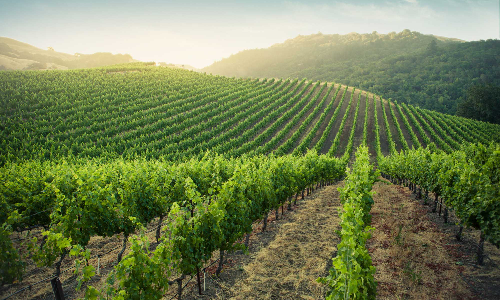
The 22
hectares of classified vines sit primarily on clay-limestone soils on
the côte (slopes) of the plateau, with some parcels extending onto the
limestone plateau itself. These soils provide natural drainage, controlled
water stress, and excellent mineral expression — qualities that have been
recognised since antiquity. The south-facing aspect ensures generous sun
exposure, while the more continental microclimate of Saint-Émilion, distinct
from the Médoc's maritime influence, promotes slow, even ripening.
The
vineyard is planted to approximately 70% Merlot and 30% Cabernet
Franc. The Cabernet Franc, planted on the cooler limestone plateau parcels,
contributes the estate's characteristic aromatic lift and structural precision
— a counterpoint to the Merlot's natural generosity and roundness.